The Slow Death of Joy
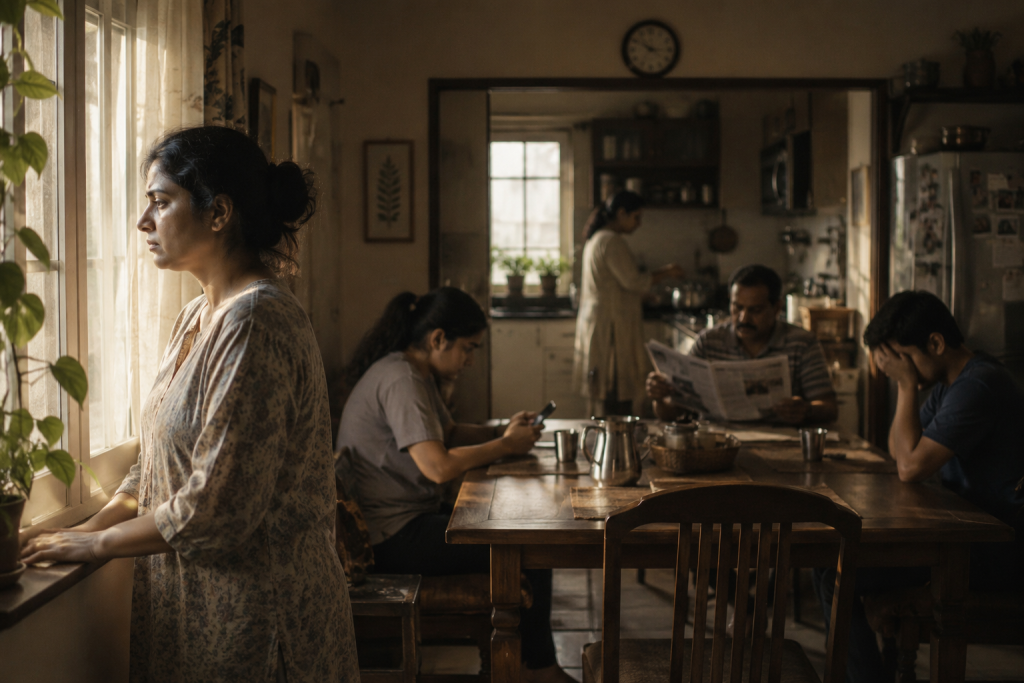
There are homes where people sleep eight hours and still wake up exhausted.
Not the exhaustion of hard work after a fulfilling day.
A deeper exhaustion that sits in the body before the day has even begun.
The alarm rings. Someone sighs heavily before getting out of bed. Another wakes up already irritated. Someone complains about acidity, constipation, body pain, bloating, fatigue, headaches or joint pain. Tea is made. Breakfast is cooked. Conversations begin, but they are sharp, reactive, rushed.
No one is truly resting in themselves.
The house functions but does it feel alive?
There is criticism disguised as concern. Emotional heaviness disguised as responsibility. Constant tension disguised as normal adulthood. People reacting instantly instead of responding consciously. Faces that rarely soften. Bodies that rarely relax.
And perhaps most painfully, an inability to genuinely feel joy for another person’s happiness.
A daughter laughs too loudly and someone immediately corrects her. A young woman dances freely and the room becomes uncomfortable. Someone shares exciting news and instead of celebration, there is caution, comparison, judgment, or subtle resentment.
Not because these people are evil.
Somewhere along the way, joy left the building. And nobody noticed.
Adaptation Becomes Virtue
Society praises people who adapt well.
The woman who tolerates everything. The man who suppresses emotion and carries responsibility silently.
The daughter-in-law who “adjusts.”
The family that maintains appearances despite emotional suffocation underneath it all.
Especially within many arranged marriage systems, people are often pushed into lives they never consciously chose.
Don’t get me wrong, not all arranged marriages are unhappy. Not all joint families are unhealthy. Some are deeply loving, supportive, and beautiful.
However, many people enter these structures through fear rather than freedom.
Fear of rejection.
Fear of disappointing family.
Fear of being alone.
Fear of society.
Fear of being judged for choosing differently.
So they adapt.
Again, don’t get me wrong, adaptation itself is not unhealthy. Love requires adaptation. Relationships require compromise. Community requires flexibility.
But forced adaptation slowly becomes self-erasure.
Women especially are often expected to enter already established family systems and absorb themselves into them quietly. To adapt, absorb, tolerate, serve, adjust, smile, keep peace, and continue giving even when emotionally exhausted.
As Angela Carter once wrote:
“All her life, she has been groomed for the slaughterhouse.”
A brutal sentence. One that reveals how deeply women are conditioned for sacrifice long before marriage even begins.
And over time, repeated self-abandonment changes people.
The Difference Between Novelty and Joy
I think many people do not actually know what joy is.
What they know instead is novelty.
Novelty of a wedding, a promotion, a new house, having children, shopping, a festival, a vacation.
Aren’t these just temporary emotional stimulation.
But once novelty fades, people are left alone with the emotional architecture of their lives.
And if that life lacks freedom, rest, emotional safety, self-expression, movement, meaning, individuality, tenderness, connection, then misery quietly returns underneath the routine.
So people convince themselves:
“This is adulthood”, “I am being responsible”, “This is sacrifice”, “This is just life.”
Perhaps human beings were never meant to live disconnected from joy for decades.
I am not saying joy as entertainment, but Joy as aliveness.
The joy of waking up happy to another morning, feeling sunlight on your skin.
Feeling agile and alive in your body.
Listening to music and being able to dance freely.
Watering your plants, making your coffee and stopping to smell it, Creating, Resting without guilt.
Loving without resentment.
Serving others from fullness instead of lack.
There is a difference between sacrifice born from love and sacrifice born from emotional starvation.
One nourishes life and the other slowly drains it.
When Joy Leaves the Body
As a doctor, I sometimes wonder whether entire families can become physiologically inflamed from generations of emotionally compressed living.
Not every illness is emotional, and joyful people can absolutely become sick too.
But I cannot help noticing how some homes carry chronic stress in their bodies.
Hypertension.
Diabetes.
Obesity.
Constipation.
Hemorrhoids.
Acne.
Thyroid disorders.
Arthritis.
Hormonal imbalance.
Chronic fatigue.
Bodies constantly inflamed while living emotionally inflamed lives.
Homes where nobody truly rests. Nobody breathes deeply. Nobody moves joyfully. Nobody feels free to fully be themselves.
And then we call this normal adulthood.
Maybe bodies carry unlived lives.
Maybe nervous systems forced into survival for decades eventually lose touch with softness, vitality, openness, and ease.
Maybe human beings are not designed to live too far away from themselves.
Bitterness Is Often Grief
I no longer think bitterness begins as bitterness.
I think it often begins as grief.
Grief for the self that never got to exist, dreams that were abandoned, years spent enduring instead of living, tenderness never received, freedom never experienced, joy slowly buried under responsibility.
And when grief has nowhere to go, it hardens.
Into criticism.
Control.
Emotional rigidity.
Resentment.
Reaction.
And eventually – Bitterness!
Sometimes the bitter older person in the house was once the young woman who never got to become herself.
That does not excuse harmful behaviour. But it reveals something deeper than simply calling people negative or toxic.
It asks what repeated self-abandonment does to a human being over decades.
Adaptation Over Aliveness
Perhaps the real tragedy is in a Society that often teaches people to value adaptation more than aliveness.
To belong instead of becoming.
To suppress instead of express.
To survive instead of truly living.
Because choosing aliveness is risky.
It may require disappointing family.
Questioning tradition.
Being misunderstood.
Choosing differently.
Standing alone for some time.
And many people would rather abandon themselves than risk social rejection.
So they slowly die within before they are dead. Becoming functional but no longer fully ALIVE.
And maybe the real question is not whether people are adjusting well.
Maybe the real question is:
What kind of life allows a human being to remain alive inside it?
Very well written post, well analysed.